HELOCs in 2026: Tap Home Equity for Debt or Big Goals?
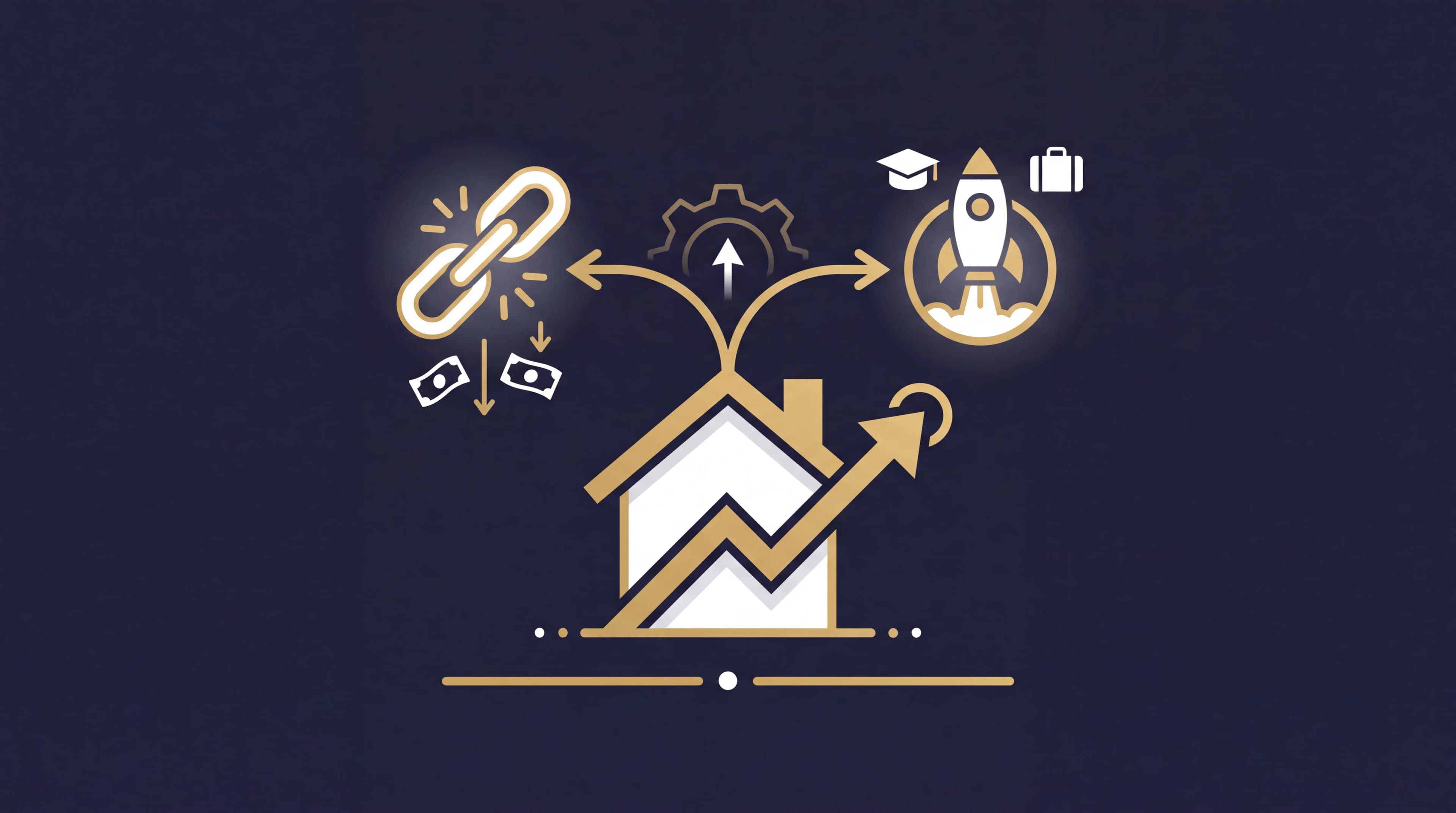
HELOCs in 2026: Tap Home Equity for Debt or Big Goals?
If you own a home right now, you are probably dealing with a strange financial contradiction. On paper, you might look incredibly successful. Your home value has likely shot up over the last few years, giving you a massive financial cushion. In reality, your monthly budget might feel tighter than ever thanks to stubbornly high living costs and rising credit card balances.
Should you tap your home equity to pay off debt or fund big goals in 2026? The short answer is yes for high-interest debt consolidation if you have fixed your spending habits, but no for funding depreciating assets or lifestyle expenses. You are not alone in feeling this squeeze. According to Gallup (2026), a record 55% of Americans feel their financial situation is getting worse. The high cost of living continues to be the top financial problem for families, with 31% of people citing inflation and high prices as their primary concern. When you combine higher energy bills, expensive groceries, and rising healthcare costs, it is easy to see why so many newer earners and young professionals are feeling the pressure.
This tension between having a lot of housing wealth and very little extra cash has made home equity lines of credit (HELOCs) incredibly popular in 2026. A HELOC allows you to borrow against the value of your home to pay off high-interest debt or fund major projects. But turning your home into a piggy bank comes with serious risks.
Before you sign any paperwork, we need to look at the real math, the hidden dangers, and the exact reasons why so many homeowners are choosing this path.
What Home Equity Means for Homeowners in 2026
To understand why HELOCs are having a moment, we first need to talk about the wealth trapped in your property. Home equity — the portion of your property's current market value that you actually own outright, calculated by subtracting your mortgage balance from the home's value.
For example, if your home is worth $500,000 and you owe $100,000 on your mortgage, your equity is $400,000. That is the part of the property not tied up by debt.
Over the past decade, rising home prices have created a massive pool of wealth for property owners. According to Bankrate (2026), the collective value of equity for U.S. households recently reached approximately $34.5 trillion. That is a staggering amount of financial capacity stored inside drywall and roof shingles.
Equity is not static. It changes as you make your monthly mortgage payments, as local real estate markets fluctuate, and as you take on new loans. In our current environment, many homeowners are locked into historically low mortgage rates from a few years ago. They do not want to sell their homes or refinance because they would lose those amazing rates. They are looking for ways to access their trapped wealth without touching their primary mortgage.
The bottom line: Home equity represents a massive pool of trapped wealth, but accessing it requires careful strategy to protect your primary mortgage rate.
HELOCs vs. Home Equity Loans: Understanding the Difference
If you want to access your home equity without selling your house, you generally have two main options, but many consumers confuse how they actually work. You can get a home equity line of credit (HELOC) or a home equity loan. According to a FirstClose survey (2026), nearly 40% of respondents did not know the difference between them.
HELOC (Home Equity Line of Credit) — a revolving line of credit secured by your home that allows you to draw funds as needed during a set timeframe, typically with a variable interest rate. You are approved for a specific credit limit, and you only pay interest on the money you actually borrow. The catch is that if the Federal Reserve changes rates, your monthly payment can go up or down.
A home equity loan is entirely different. It is a closed-end loan where you receive a single lump sum of cash upfront. You pay it back with a fixed interest rate over a set schedule, much like a traditional car loan or student loan.
The FirstClose survey also revealed a massive misconception keeping people from using these tools. About 37% of respondents mistakenly believed that taking out a HELOC would force them to give up their historically low first-mortgage interest rate. This is completely false. Both HELOCs and home equity loans are considered second liens. They sit entirely separate from your primary mortgage, leaving your original low rate completely untouched.
Here's what this means: Both HELOCs and home equity loans are second liens that leave your primary mortgage rate untouched, but they function very differently in how you access and pay for the money.
The Math Behind Tapping Home Equity for Debt Consolidation
The reason HELOCs are surging in popularity comes down to simple math: credit card debt has become incredibly expensive to carry.
According to a NerdWallet study (2026), total revolving credit card debt in the U.S. reached $626.8 billion recently. Households that carry revolving balances owe an average of $10,563 across their cards. Worse, according to Forbes Advisor (2026), the average credit card interest rate was sitting at a painful 27.9%.
Now compare that to the cost of borrowing against your home. According to Bankrate (2026), the average HELOC rate is about 7.43%. Experian data similarly places the average HELOC rate right around 7.54%.
If you are carrying $10,000 in credit card debt at 28% interest, you are bleeding cash every single month just to tread water. Swapping that 28% interest rate for a 7.5% HELOC rate can save you thousands of dollars and dramatically lower your monthly payments. Are you struggling with high-interest balances? You might want to explore how to consolidate credit card debt in 2026 to see if a HELOC or another method makes sense for your specific situation.
Because of this massive rate difference, homeowners are flocking to HELOCs. According to the Federal Reserve Bank of New York (2026), HELOC balances grew for 16 consecutive quarters, reaching $446 billion. According to Experian (2026), the average HELOC balance grew by 11.2% in a single year, hitting $52,347. People are clearly using their homes to bail out their budgets.
The bottom line: Swapping 28% credit card interest for a 7.5% HELOC rate can save you thousands of dollars, making debt consolidation the primary driver of HELOC growth.
Smart Reasons vs. Risky Reasons to Use a HELOC
Just because you can borrow against your house does not mean you always should, as data shows a sharp divide in how different generations view home equity.
Smart Uses: Debt Consolidation and Home Improvements
According to the Mortgage Bankers Association (2026), 39% of borrowers cited debt consolidation as their primary reason for tapping home equity. Using a HELOC to wipe out 28% credit card debt is generally considered a mathematically sound move, provided you actually stop using the credit cards.
Home improvements are another widely accepted reason. According to a Bankrate survey (2026), 55% of homeowners view home improvements or repairs as a good reason to tap equity. This makes sense because updating a kitchen or fixing a roof can increase the overall value of the property, essentially putting the equity right back into the home.
Risky Uses: Funding Lifestyle and Discretionary Purchases
Younger homeowners are increasingly willing to use their homes to fund their lifestyles. Bankrate notes that 23% of millennial homeowners believe pulling cash out just to cover routine expenses is a good idea. FirstClose found that 34% of respondents would use home equity for big discretionary purchases like a car, a vacation, or tuition.
Using a 20-year loan secured by your house to pay for a two-week vacation to Europe is a dangerous financial game. You are converting short-term fun into long-term debt, and you are putting your living situation at risk to do it.
Here's what this means: Using a HELOC to build long-term value or eliminate high-interest debt is a smart financial move, but using it to fund vacations or lifestyle inflation puts your home at unnecessary risk.
The Hidden Dangers of Borrowing Against Your Home
The biggest risk of a HELOC is what happens if things go wrong, because you are putting your actual living situation on the line. Credit card debt is unsecured. If you lose your job and cannot pay your credit card bill, your credit score will tank. You will deal with collections agencies, but you will still have a roof over your head.
Secured debt — a loan backed by a physical asset, like your house, which the lender can seize if you fail to make payments. A HELOC is secured debt. If you fail to make your HELOC payments, the lender can foreclose on your property. You are literally betting your house that you will be able to make those monthly payments for the next ten to twenty years.
There is also a massive behavioral trap with debt consolidation. Many people take out a HELOC, pay off $15,000 in credit card debt, and feel a huge sense of relief. But because they never fixed the underlying spending habits that caused the debt in the first place, they start using their credit cards again. Two years later, they have a $15,000 HELOC balance and $15,000 in new credit card debt.
If you are trying to break the cycle of debt, the tool you use matters less than the habits you build. You can learn more about building those habits in our guide on how to pay off debt when starting from zero. Consolidating debt only works if you commit to living on a strict budget afterward.
You also have to consider the knowledge gap. According to FirstClose (2026), 44% of respondents did not even know the interest rate on their current credit cards, and 77% did not know the average rate for a HELOC. You cannot make a smart financial decision if you do not know your own numbers.
The bottom line: A HELOC puts your physical home on the line, and without changing your underlying spending habits, you risk doubling your debt burden.
Should You Get a HELOC in 2026?
Deciding whether to tap your home equity in 2026 requires brutal honesty about your financial habits and your future plans. If you are weighing your options, ask yourself a few practical questions.
First, are you fixing a root cause or just treating a symptom? Maybe you have high credit card debt because of a one-time medical emergency or a temporary job loss. If that issue is resolved, a HELOC can be a brilliant way to clean up the mess at a lower interest rate. If you have credit card debt because you consistently spend more than you earn, a HELOC will only make your situation worse in the long run.
Second, what is the lifespan of what you are buying? It is generally safe to use long-term debt for long-term assets. Using a HELOC for a necessary roof replacement makes sense. Using a HELOC to buy a depreciating asset like a car (or worse, everyday groceries) is a recipe for disaster.
Third, how stable is your income? HELOCs have variable rates, meaning your payment could increase if the economy shifts. You need to ensure your monthly cash flow can handle potential rate hikes. If your budget is already stretched to the breaking point, adding a second mortgage payment might push you over the edge.
The housing market itself is also shifting. With high interest rates and changing local markets, the traditional rules of real estate are evolving. You might not be entirely sure you will stay in your home long enough to make a HELOC worthwhile. If so, review the current market dynamics to decide if you should buy or rent in 2026.
A HELOC is just a tool. It is neither inherently good nor bad. When used by a disciplined homeowner to lower interest costs or improve property value, it can be incredibly effective. When used as a band-aid for chronic overspending, it can threaten your financial security.
Here's what this means: A HELOC is a powerful financial tool that requires disciplined spending, stable income, and a clear plan to pay off the balance.
Common Questions About HELOCs in 2026
What is the average HELOC rate in 2026?
The average HELOC rate in 2026 is approximately 7.4% to 7.5%, depending on the lender and your credit score. This rate is significantly lower than the average credit card interest rate, making it an attractive option for debt consolidation.
How does a HELOC impact my primary mortgage?
A HELOC does not impact the interest rate or terms of your primary mortgage. It functions as a separate second lien on your property, allowing you to keep your historically low first-mortgage rate intact.
Why is it risky to use a HELOC for everyday expenses?
It is risky to use a HELOC for everyday expenses because you are converting short-term lifestyle costs into long-term debt secured by your home. If you fail to make the payments on these discretionary purchases, the lender can foreclose on your property.
When should I use a HELOC to pay off credit card debt?
You should use a HELOC to pay off credit card debt only if you have addressed the root cause of your overspending and committed to a strict budget. Consolidating high-interest debt at a lower HELOC rate saves money, but it requires the discipline to stop using credit cards.
Your One Next Step
Do not make any decisions about your home equity based on guesswork. Your single next step is to log into your credit card accounts today and write down the exact interest rate (APR) and total balance for every card you own. Get your actual numbers on paper first. Then you can calculate exactly how much a 7.5% HELOC would save you each month. This gives you the hard data you need to make a rational, unemotional choice.
Listen to this article
AI-generated audio · Voices by ElevenLabs
Get smarter about money
One practical tip per week. No spam, no hype — just clear steps toward financial progress.

Sammy Dynamo
Software Engineer | CS Student | Technopreneur, Dyxium Inc
Related Articles
13 min read
Debt & CreditCan’t Pay Credit Card Minimums? What to Do Now
If you can’t pay credit card minimums, you are not alone. Over 10% of accounts are...
Sammy Dynamo
12 min read
Debt & CreditConsolidate Credit Card Debt in 2026: Save Your Score
Learn how to consolidate credit card debt in 2026 without tanking your credit score. Ready to...
Sammy Dynamo
10 min read
Debt & Credit2026 Student Loan Changes – How They Impact Your Budget
Upcoming student loan changes will impact your budget as 7 million lose the SAVE plan. Are...
Sammy Dynamo