Dynamic Budgeting: Adjusting When Rent and Gas Spike
Dynamic Budgeting: Adjusting When Rent and Gas Spike
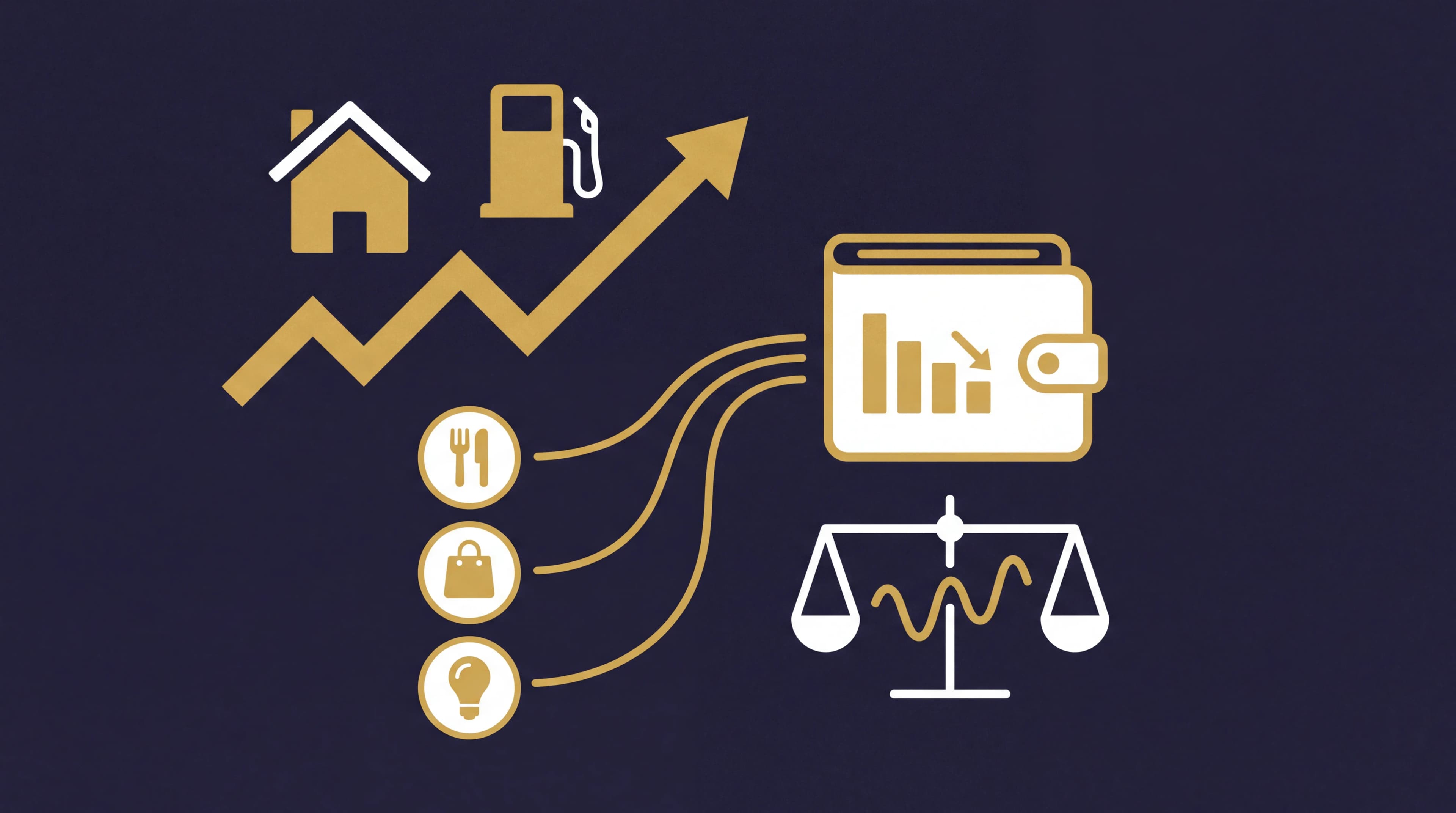
You sit down to look at your bank account, and the math just does not add up the way it used to. Your lease renewal notice is sitting on the counter with a noticeable price hike. You filled up your gas tank this morning and winced at the total. Suddenly, the financial plan that worked perfectly six months ago feels completely broken.
If this sounds familiar, you are not doing anything wrong. The cost of basic necessities has shifted dramatically. How do you adjust your spending when rent and gas spike? The answer is dynamic budgeting—a flexible strategy where you actively rebalance your spending categories in response to rising fixed costs. When your largest expenses change, your budget has to change with them.
Instead of treating your spending plan as a rigid document set in stone once a year, dynamic budgeting treats it as a living system. It is about making active, intentional adjustments when fixed costs like housing and transportation spike.
Let us look at the reality of current costs, why old budgeting rules might be failing you right now, and how to adapt your money strategy without losing sight of your long-term goals.
The Reality of the Modern Budget and Cost of Living
The baseline cost of living has fundamentally changed for young professionals and new earners, making traditional budgeting difficult. Before you blame yourself for feeling financially squeezed, it helps to look at the numbers.
According to the Congressional Research Service (2024), 49.4 percent of all renters in the United States are officially housing cost-burdened. This means 22.7 million renter households are spending more than 30 percent of their pre-tax income on rent and utilities.
This is not just a problem for minimum-wage workers. The same data shows that nearly half (48.7 percent) of renter households making between $45,000 and $74,999 are also cost-burdened. If you fall into this group, housing is likely crowding out your other financial goals.
According to the U.S. Census Bureau (2024), the median gross rent hit $1,487. For many people, figuring out how to budget and survive when rent is 40% of your income is no longer a hypothetical question. It is a daily reality.
According to the Harvard Joint Center for Housing Studies (2024), for lower-income renters, the residual income left over after paying rent and utilities dropped to just $310 per month. That leaves almost zero room for error when other bills go up.
The bottom line: When housing takes up a massive piece of the pie, your remaining dollars have to work much harder, requiring a more adaptable approach to your finances.
Why Static Budgets Fail During Inflation
Static budgets fail during inflation because fixed percentage rules cannot absorb sudden price shocks. Financial educators love to recommend the 50/30/20 rule. It suggests putting 50 percent of your take-home pay toward needs, 30 percent toward wants, and 20 percent toward savings and debt repayment.
It is a great starting point. But what happens when your needs refuse to stay under 50 percent?
According to the Bureau of Labor Statistics (2023), housing consumed 32.9 percent of the average consumer's spending. Transportation was the second-largest category at 17 percent. If you add those two together, you are already at 49.9 percent. That leaves exactly one-tenth of one percent for groceries, healthcare, and insurance before you break the 50 percent rule.
When gas prices or rent spikes, a static budget breaks. If you try to force your new, higher expenses into old percentage buckets, you will likely end up frustrated and tempted to abandon the budget entirely.
Here's what this means: Dynamic budgeting acknowledges that these percentages are guidelines, not laws of physics. If your needs temporarily jump to 60 percent of your income due to a rent hike, your budget must dynamically adjust to reduce your wants to 20 percent.
What Is Dynamic Budgeting?
Dynamic budgeting — the practice of regularly rebalancing your spending categories in response to external price shocks. It requires you to be honest about what things actually cost right now, rather than what you wish they cost.
According to Debt.com (2026), 84.67 percent of Americans report that they budget. Furthermore, according to NerdWallet (2026), 68 percent of Gen Z respondents use budgeting tools, with 43 percent relying on simple pen and paper.
If you are already tracking your money, you are halfway there. If you are new to this, learning how to build your first budget in 30 minutes is your best starting point.
The dynamic part comes into play during your monthly review. Instead of just tracking where your money went, you actively shift funds between categories based on upcoming realities.
The bottom line: If gas prices are surging due to global events, you proactively move money out of your dining out fund and into your transportation fund before the month begins.
Step 1: Redefine Your Needs and Wants
Redefining your needs and wants is essential to free up cash when fixed costs rise. Behavioral economists talk a lot about mental accounting.
Mental accounting — the human tendency to put our money into mental buckets and treat those buckets as permanent.
When costs go up, our mental accounting often works against us. We label certain conveniences as fixed needs. A premium cell phone plan, multiple streaming subscriptions, or higher-priced convenience groceries start to feel like non-negotiable expenses.
When your rent goes up by 7 to 10 percent upon renewal, you have to find that money somewhere. You can either read up on the math behind accepting a rent hike versus moving to see if relocating makes sense, or you have to free up cash in your current budget.
To do this, sit down and ruthlessly audit your needs category. If housing is taking up more space, something else has to be downgraded to a want.
- Can you switch to a discount grocery store for the next six months?
- Can you pause your gym membership and work out at home?
- Can you switch to a cheaper mobile carrier?
Here's what this means: By temporarily redefining some of your needs as wants, you create the flexibility required to absorb a rent spike without going into credit card debt.
Step 2: Tackle the Transportation Trap When Gas Spikes
Transportation costs can spike overnight, requiring immediate behavioral shifts to keep your budget intact. While a rent increase happens once a year, the cost of getting around is highly volatile.
According to the U.S. Energy Information Administration (2024), the national average retail price for regular gasoline was $3.30 per gallon, with projections rising to $3.84 per gallon in 2026 due to global supply constraints.
Gas is only part of the equation. According to NerdWallet's Vehicle Ownership Costs Index (2026), the cost of owning a car (including insurance, maintenance, and fuel) jumped nearly 11 percent between December 2024 and April 2026.
Since 87 percent of workers commute, and 78 percent of them do so by personal vehicle, you cannot simply stop driving to work. But you can dynamically adjust how you manage these costs.
How to Lower Your Commuting Costs
First, track your actual mileage for a month to see how much driving is strictly necessary. Then, look for small behavioral shifts. Carpooling twice a week, combining errands to reduce trips, or taking public transit when feasible can shave 10 to 20 percent off your monthly fuel costs.
Next, shop your auto insurance. If your premium went up, do not just accept it.
The bottom line: Getting a new auto insurance quote every six months and reducing unnecessary driving are core dynamic budgeting habits that can offset the rising cost of gas.
Step 3: Protect Your Savings During a Rent Increase
Maintaining your savings momentum, even at a reduced rate, protects you from future financial emergencies. When fixed costs spike, the easiest thing to do is stop saving. It feels like a victimless crime in the short term. But completely halting your savings leaves you exposed to the next financial emergency.
According to Debt.com (2026), 39 percent of budgeters cite growing wealth and savings as their main motivation. Financial planners agree that you should try to maintain at least some savings momentum, even during expensive months.
Dynamic budgeting allows for compromise. If you normally save 20 percent of your income, and a rent hike eats up an extra 5 percent, it is perfectly acceptable to temporarily drop your savings rate to 15 percent.
The key word is temporarily.
Keep contributing enough to get any employer match on your retirement accounts. Keep trickling a small amount into your emergency fund. Maintain your minimum debt payments.
Here's what this means: You can pause aggressive extra investments, but keeping the habit alive prevents you from having to restart from zero later. Once your income increases or you move to a cheaper apartment, you can dynamically adjust that savings rate back up.
Step 4: Overcome the Mental Friction of Budget Cuts
Adjusting your lifestyle downward is psychologically difficult, but framing it as a temporary experiment reduces mental friction.
Loss aversion — the psychological phenomenon where we feel the pain of giving up a convenience much more strongly than the pleasure of gaining a similar benefit.
We also suffer from status quo bias.
Status quo bias — the preference to keep doing what we are doing and hope things work out.
According to Gallup (2026), 29 percent of adults name inflation or the high cost of living as the most important financial problem facing their family. We know it is a problem, but taking action feels exhausting.
To overcome this friction, frame your budget cuts as a temporary experiment rather than a permanent loss. Tell yourself you are pausing your takeout habit for 60 days to handle the new gas prices. A 60-day challenge feels manageable. A lifetime ban feels like a punishment.
The bottom line: Remind yourself that you are in control. The economy will do what it does, and prices will fluctuate. But deciding exactly how your paycheck is spent gives you immediate authority over your situation.
Common Questions
What is dynamic budgeting?
Dynamic budgeting is a flexible financial strategy where you actively adjust your spending categories in response to changing costs. Instead of sticking to rigid percentages, you shift funds to accommodate spikes in essential expenses like rent and gas.
How do I adjust my budget when rent increases?
You adjust your budget for a rent increase by temporarily redefining some of your non-essential needs as wants. By cutting back on discretionary spending, such as dining out or subscription services, you can free up cash to cover higher housing costs without going into debt.
Why is the 50/30/20 budget rule failing me right now?
The 50/30/20 rule often fails during periods of high inflation because fixed costs can easily exceed 50 percent of your income. When housing and transportation prices spike, rigid percentage rules cannot absorb the shock, requiring a more dynamic approach to your spending.
When should I review and adjust my dynamic budget?
You should review and adjust your dynamic budget monthly, or immediately after experiencing a major price shock. Proactively shifting funds before the month begins ensures you have enough money allocated for surging expenses like gas or utilities.
Your One Next Step
Open your bank app or credit card statement right now and calculate exactly how much you spent on housing, utilities, and transportation last month. Divide that number by your total take-home pay. If those three things are eating up more than 50 percent of your income, you need to adjust your discretionary spending this week to keep your budget balanced.
Your Money. Your Terms.
Listen to this article
AI-generated audio · Voices by ElevenLabs
Get smarter about money
One practical tip per week. No spam, no hype — just clear steps toward financial progress.

Sammy Dynamo
Software Engineer | CS Student | Technopreneur, Dyxium Inc
Related Articles
12 min read
BudgetingLease Renewal Math: Accept a Rent Hike or Move in 2026?
Facing a rent hike? Use this lease renewal math to decide if you should stay or...
Sammy Dynamo
10 min read
BudgetingRent is 40% of Your Income? How to Budget and Survive
When rent is 40% of your income, traditional financial advice fails. Learn how to adapt your...
Sammy Dynamo
11 min read
BudgetingBare-Bones Budget for Layoffs: Find Your Survival Number
A bare-bones budget is your ultimate defense against a layoff scare. Learn how to calculate your...
Sammy Dynamo