Inflation Illusion: Why Your Budget Feels Tighter
Listen to a conversation about this article
7 minAI-generated conversation with synthetic voices.
Playback speed
Read the transcript
Host 1: You finally get that promotion and hit the salary number you always wanted but your budget actually feels tighter than ever. You're earning more money today but somehow you feel completely broke by the end of the month.
Host 2: Honestly it's the most frustrating feeling in the world. You look at your bank account and the math just doesn't seem to make any sense at all. You feel like you're doing everything right but still falling behind.
Host 1: You aren't bad at math though. You're just experiencing something economists call the inflation illusion. It's a psychological disconnect that happens to almost everyone.
Host 2: Right so that's when your actual paycheck goes up but your purchasing power goes down because life costs more. You get more dollars but those dollars don't stretch as far.
Host 1: Exactly. When we talk about money we usually focus on that nominal income. That's just the raw dollar amount on your paystub.
Host 2: But a dollar is only worth what it can actually buy at the grocery store or the gas pump. And you know those prices have been out of control lately.
Host 1: And that brings us to the biggest invisible weight on your budget right now. The main culprit here is cumulative inflation.
Host 2: Because we keep hearing on the news that inflation is cooling down. They make it sound like everything is getting better and going back to normal.
Host 1: But slowing inflation doesn't mean falling prices. It just means prices are rising a little bit slower now than they were last year.
Host 2: So the things we buy every day aren't going back to how they were a few years ago. We're stuck with these new price tags.
Host 1: Not at all. Consumer prices are actually twenty six percent higher today than they were in December 2019. That's based on data from the Bureau of Labor Statistics.
Host 2: Wow. So even if inflation technically slows down we're still paying a quarter more for basically everything. That's a massive jump.
Host 1: Right and that compounds over time. That twenty six percent cumulative increase is just sitting right there on top of your monthly budget.
Host 2: That makes so much sense because my personal expenses feel way higher than whatever the national average says. The news says three percent but my wallet says something else.
Host 1: That's your personal inflation rate at work. The headline rate is just a big average. It blends everything together like used cars and medical care and electronics.
Host 2: But you don't buy a used car every single month. I buy groceries and pay rent and put gas in my car literally every single week.
Host 1: And those specific essential categories are rising way faster than the overall average. Food away from home went up over four percent recently.
Host 2: I feel like half my paycheck just vanishes into housing and transportation before I even do anything fun. It's honestly exhausting.
Host 1: You aren't alone there. Rent prices have actually risen one point five times as fast as wages since 2019.
Host 2: So even when my boss gives me a decent raise it feels like I'm still totally falling behind. My rent eats the whole raise.
Host 1: Because you probably are falling behind in real terms. Employers try to keep up but they usually fall short.
Host 2: Wait what do you mean by real terms. Are you talking about how far the money actually goes.
Host 1: Yes. For example the average planned merit increase recently was just three point two percent.
Host 2: Which sounds okay on paper. But then you realize inflation might be hovering around four percent.
Host 1: Exactly. So a standard three percent raise is essentially a pay cut when you look at your actual purchasing power.
Host 2: That's so depressing but it explains why I feel so stressed out every time I go to the store. I always feel like I'm doing something wrong.
Host 1: Behavioral economists call that the money illusion. Our brains focus on the higher dollar amount instead of the actual buying power.
Host 2: Plus you have frequency bias right. That's where you constantly notice price hikes on the things you buy all the time.
Host 1: Yes. When a box of cereal goes up two dollars you notice it immediately because you buy it weekly. It causes a lot of anxiety.
Host 2: But I don't notice that a flat screen television is cheaper because I only buy one every ten years. The painful stuff is what I see daily.
Host 1: Exactly. And loss aversion makes the pain of paying higher prices feel twice as intense as the joy of getting a raise.
Host 2: So my brain is basically wired to panic every time I swipe my card at the grocery store. It's literally a psychological trap.
Host 1: It's totally valid anxiety. The gap between your paycheck and your living expenses is a really heavy burden to carry right now.
Host 2: And people are running out of savings trying to cover that gap right. People are just trying to keep their heads above water.
Host 1: Yes. Only forty seven percent of Americans have enough cash on hand to cover a one thousand dollar emergency expense.
Host 2: That means more than half the people out there are just one flat tire away from serious financial trouble. That's terrifying.
Host 1: And when the cash runs dry they turn to credit cards just to survive. Credit card debt is over one point two trillion dollars right now.
Host 2: But they aren't using those credit cards for fun vacations right. They're just trying to get by.
Host 1: No. About seventy three percent of people carrying a balance are using it for essentials. They're buying groceries and paying medical bills.
Host 2: They're literally using credit cards with twenty four percent interest just to buy basic everyday needs. That's a brutal cycle to get stuck in.
Host 1: Which is exactly why we need to talk about how to build an inflation aware budget today. You have to adapt to the current reality.
Host 2: I'm guessing step one is to stop budgeting like it's still 2019. We have to let go of those old numbers.
Host 1: Exactly. You have to reset your financial anchors. If you try to keep your grocery budget at three hundred dollars you'll fail.
Host 2: Because prices are up twenty six percent. So my budget categories need to increase by at least that much just to maintain my life.
Host 1: Right. So the best way to start is to track your actual spending for thirty days. Don't judge yourself at all during this process.
Host 2: Just write it down and see exactly what my life costs right now. No guilt and no shame.
Host 1: Yes. You might find your basic needs take up sixty five percent of your income instead of the traditional fifty percent.
Host 2: And once I know the real numbers I can actually make some informed choices. I can see where my money is actually going.
Host 1: Right. You might need to negotiate bills or look for ways to increase your income. Or you might need to prioritize cash savings.
Host 2: Because having cash in the bank protects you from putting basic needs on a high interest credit card when things get tough.
Host 1: Exactly. So your one takeaway today is to pull your statements and calculate exactly what you spent on housing groceries and transportation last month.
Host 2: Don't punish yourself for missing old financial goals. Just adjust your baseline to reflect reality and move forward from there.
Host 1: Figure out that true percentage of your income going to survival and build your new plan based on today. You can find more practical guides for your money at geldzak dot com.
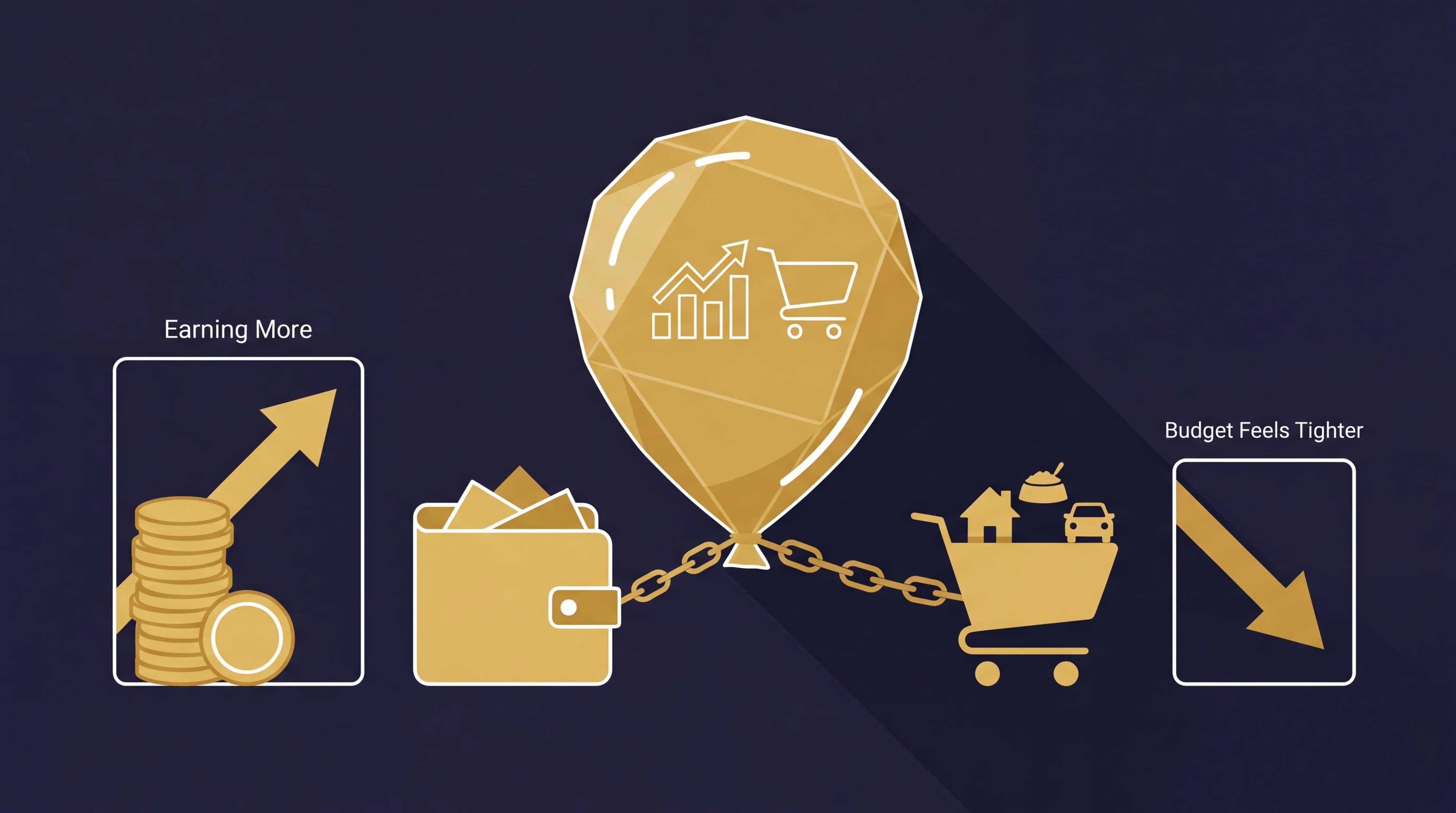
You got the promotion. You finally hit that salary number you were aiming for a few years ago. By all accounts, you are doing everything right in your career. Yet, when you look at your bank account on the 28th of the month, the math does not seem to add up. You are earning more than ever, but your budget feels tighter than it did when you were making less money.
You are not bad at math. You are experiencing what economists call the inflation illusion. Inflation illusion — the psychological disconnect where your nominal income increases, but your actual purchasing power decreases due to rising living costs. This explains exactly why your budget feels tighter even though you are earning more money: the cost of housing, food, and transportation has simply outpaced your wage growth.
When we talk about money, we usually focus on the dollar amount on our paychecks. We look at our nominal income. But a dollar is only worth what it can actually buy. While wages have grown over the past few years, the cost of keeping a roof over your head, putting food on the table, and driving to work has grown faster.
Let us break down why this is happening, what the numbers actually say, and how you can adjust your finances to match reality.
The Math Behind the Inflation Squeeze
Cumulative inflation is the primary reason your paycheck does not stretch as far as it used to. To understand why your budget feels so constrained, we have to look at how these price increases stack up over time. We often hear news reports celebrating that inflation has cooled down. And it is true that inflation has slowed from its massive 9.1 percent peak in June 2022.
But slowing inflation does not mean falling prices. It just means prices are rising at a slower pace than they were before.
According to Bankrate (2026), consumer prices are 26 percent higher than they were in December 2019, based on data from the Bureau of Labor Statistics (BLS). This means that even if inflation has technically come down, the prices you pay at the store have not gone back to normal. They are roughly a quarter higher than they were just a few years ago.
According to the Bureau of Labor Statistics (2025), the Consumer Price Index rose 2.9 percent from December 2023 to December 2024, and another 2.7 percent by December 2025. According to Trading Economics (2026), the annual inflation rate then accelerated slightly to 3.8 percent in April 2026.
These numbers are much better than the massive spikes we saw during the pandemic recovery. But they are still compounding on top of prices that were already heavily inflated. That 26 percent cumulative increase is the invisible weight sitting on your monthly budget.
The bottom line: Even though the inflation rate has slowed down, prices are still compounding on top of the massive 26 percent increase we have seen since 2019.
Your Personal Inflation Rate vs. The Average
Your personal inflation rate often feels much higher than the national average because essential living expenses are rising faster than discretionary items. Personal inflation rate — the actual rate of price increases based on your specific spending habits and household expenses.
The headline inflation rate is an average. It blends the cost of everything from used cars to medical care to electronics. But you do not buy a used car every month. You buy groceries, you pay rent, and you put gas in your tank.
If the things you buy most often are rising in price faster than the national average, your personal inflation rate is going to feel much worse than the news suggests.
Take food, for example. According to the Bureau of Labor Statistics (2025), while overall prices rose 2.7 percent, food away from home went up 4.1 percent. The year before that, meats, poultry, fish, and eggs jumped 4.2 percent, with egg prices alone seeing a dramatic 36.8 percent rebound.
Then there is housing and transportation. According to the BLS Consumer Expenditure Surveys (2024), average annual household expenditures were $78,535. Housing accounted for $26,266 of that total, and transportation took up $13,318. This means that roughly half of the typical household budget goes to just two categories.
If you are a renter, the situation is even more pronounced. According to NerdWallet (2026), rent prices have risen 1.5 times as fast as wages since 2019. Over the 12 months ending in April 2026, rent rose 3.3 percent, while gasoline prices surged 28.4 percent.
When half of your income goes toward housing and transportation, and those specific categories are experiencing rapid price hikes, it is easy to see why middle-income millennials live paycheck to paycheck. Your living expenses are outpacing your earning potential.
Here's what this means: If the bulk of your income goes toward housing and transportation, your personal cost of living is rising much faster than the headline inflation rate suggests.
The Gap Between Your Paycheck and Purchasing Power
Wage growth is consistently failing to keep up with the true increase in the cost of living. So, what about your paycheck? Employers have been raising wages, but the increases often fail to cover the true increase in everyday expenses.
According to the Social Security Administration (2024), the National Average Wage Index was $69,846, which was 4.84 percent higher than the previous year. On paper, a near 5 percent raise sounds fantastic. But once the Census Bureau adjusted median household incomes for inflation, they found that the real, inflation-adjusted gains were incredibly modest.
Nominal Wages vs. Real Wages
To understand this gap, we have to look at two key concepts. Nominal wages — the actual dollar amount you are paid before adjusting for inflation. Real wages — the actual purchasing power of your income after accounting for the cost of living.
This is not a new problem. Economists at the Pew Research Center highlight a crucial distinction between these two metrics. According to the Pew Research Center (2026), median weekly wages more than doubled between the end of 1999 and the end of 2025, rising from $482 to $1,040.
However, once you adjust those wages into constant dollars to account for inflation, real buying power over that 26-year span increased by only 12.1 percent.
This framing perfectly explains the inflation illusion. You look at your paycheck and see a number that is twice as large as what you might have made early in your career. You feel like you should be getting ahead. But because the cost of living has risen almost perfectly in tandem with your wages, your actual purchasing power has barely moved.
Even today, employers are trying to keep up, but falling short. According to Mercer (2025), the average planned merit increase for employees was 3.2 percent. When inflation is hovering around 2.7 to 3.8 percent, a 3.2 percent raise is not a raise at all. It is just a cost-of-living adjustment that barely keeps your head above water.
The bottom line: A standard 3 percent raise is essentially a pay cut when inflation is hovering near 4 percent, leaving your actual purchasing power stagnant.
Money Illusion and the Psychology of Prices
Our brains are wired to focus on the dollar amount we earn rather than the purchasing power of those dollars, creating a false sense of financial security. Beyond the raw math, there is a psychological component to why your budget feels so stressful right now.
Behavioral economists use the term "money illusion" to describe our tendency to think of our wealth in nominal terms rather than real terms. Money illusion — the psychological tendency to view wealth and income in nominal dollar terms rather than real, inflation-adjusted terms. When you get a 4 percent raise, your brain registers it as a clear victory. You feel wealthier. But if inflation is 5 percent, you are actually losing ground. The illusion makes it hard to accurately gauge your financial health.
Consumer psychologists also point to frequency bias and loss aversion as major drivers of financial stress. Frequency bias — the cognitive bias where we overestimate the inflation rate because we frequently notice price increases on everyday items like groceries. Loss aversion — the behavioral principle where the psychological pain of losing money (or paying higher prices) is twice as intense as the joy of gaining money.
The Kahler Financial Group notes that consumers remain deeply anxious about prices because of how often they interact with them. You go to the grocery store every week. When a box of cereal goes up by two dollars, you notice it immediately. That frequent exposure to higher prices causes anxiety. You do not buy a television every week, so you do not notice that the price of flat-screen TVs has actually gone down. The painful, frequent purchases dominate your perception of the economy.
Loss aversion amplifies this pain. We feel the sting of a price increase much more intensely than we feel the relief of a price drop. If the cost of your favorite coffee goes up 15 percent, it ruins your morning. If the price of natural gas drops 15 percent, you probably do not even look closely at your utility bill to celebrate.
Understanding these mental traps is a big part of the psychology of spending and why you're not bad with money. Your brain is wired to notice the threats to your financial security, which makes the current economic environment feel incredibly heavy.
Here's what this means: Your financial anxiety is valid because your brain is constantly processing the pain of frequent price hikes at the grocery store and gas pump.
The Hidden Cost of Coping with Inflation
When wages fail to cover rising living expenses, consumers are increasingly forced to rely on debt and depleted savings just to survive. Unfortunately, those coping mechanisms are creating a fragile financial environment for many young professionals.
According to Bankrate (2026), only 47 percent of Americans have enough cash on hand to cover a $1,000 emergency expense. Nearly one in four people have no emergency savings at all. More than half of the respondents said they are saving less for emergencies specifically because of inflation and rising everyday prices.
When savings run dry, people turn to credit. According to Academy Bank (2025), U.S. adults carried over $1.21 trillion in credit card debt by the second quarter of the year, with an average balance of about $5,595 per cardholder.
The most alarming part of this data is not just the total amount of debt, but what the debt is being used for. About 73 percent of those carrying a balance are using their credit cards to pay for essential costs like car repairs, medical bills, and everyday living expenses. They are not maxing out their cards on vacations. They are using revolving credit just to cover basic needs.
All of this takes a massive toll on mental health. According to Bankrate (2025), 43 percent of U.S. adults say money negatively affects their mental health. Among that group, 69 percent cite inflation and rising prices as a major reason for their anxiety, stress, and lost sleep.
If you have been feeling exhausted by managing your money lately, you are entirely normal. The gap between what you earn and what it costs to live is a heavy burden to carry.
The bottom line: The gap between income and expenses is forcing people to use high-interest credit cards for basic survival, leading to widespread financial stress.
How to Build an Inflation-Aware Budget
To survive the inflation illusion, you must build a budget based on today's prices rather than outdated financial anchors. Understanding the inflation illusion is the first step. The next step is adjusting your financial habits to survive it. You cannot control the Consumer Price Index, but you can control how you allocate your paycheck.
Here is how to adapt your budgeting strategy for the current reality.
Resetting Your Financial Anchors
First, you have to reset your mental anchors. Many of us are still budgeting based on what things cost in 2019. If you are still trying to keep your grocery budget to $300 a month because that is what worked five years ago, you are setting yourself up for failure and guilt. Prices are up 26 percent. Your budget categories need to increase by at least 26 percent just to maintain the same standard of living.
Second, you need to track your actual spending for 30 days without judging yourself. Do not try to change your habits yet. Just write down exactly what your life costs right now. You might be surprised to find that your "needs" category is taking up 65 percent of your income instead of the traditional 50 percent recommended by most financial planners.
Once you know your real numbers, you can start making informed choices. GreenPath Financial Wellness stresses that coping with inflation requires difficult choices about raising income or cutting expenses. If your fixed costs (rent, utilities, insurance, basic food) are consuming too much of your paycheck, you only have a few options. You can negotiate your bills, find a roommate, move to a cheaper area, or focus on increasing your income through job hopping or side work.
If you are not sure where to start with organizing these numbers, take a step back and learn how to build your first budget in 30 minutes. A simple spreadsheet or a piece of paper is all you need to get a clear picture of your cash flow.
Finally, prioritize liquidity over aggressive debt payoff if your emergency fund is empty. When prices are unpredictable, having cash in the bank is your best defense against putting basic needs on a credit card at 24 percent interest. Even a small buffer of $1,000 can protect you from the most common financial shocks.
Here's what this means: You need to track your actual spending, accept that your basic needs now cost 26 percent more than they did in 2019, and prioritize cash savings over aggressive debt payoff.
Common Questions
What is the inflation illusion?
The inflation illusion is the psychological disconnect where you feel wealthier because your nominal income has increased, but your actual purchasing power has decreased. This happens because the cost of living rises faster than your wage growth. Ultimately, your budget feels tighter because your money buys less than it used to.
Why does my budget feel so tight when I make more money?
Your budget feels tight because cumulative inflation has driven consumer prices up 26 percent since 2019. Even if you have received raises or promotions, your real wages have likely remained stagnant or dropped. You are earning more nominal dollars, but your essential expenses like housing and food take up a larger percentage of your paycheck.
How do I calculate my personal inflation rate?
You can calculate your personal inflation rate by tracking your monthly spending on essential categories like housing, groceries, and transportation, and comparing it to previous years. Because headline inflation is just an average, your personal rate will be higher if you spend a large portion of your income on categories experiencing rapid price hikes.
When will prices go back down to normal?
Prices are unlikely to go back down to 2019 levels, as slowing inflation simply means prices are rising at a slower pace, not falling. Deflation, or a broad drop in prices, is rare and usually signals a severe economic recession. Instead of waiting for prices to drop, focus on adjusting your budget to match the current cost of living.
Your One Next Step
Open your bank or credit card statements from the last 30 days and calculate exactly how much you spent on your top three essential categories (usually housing, groceries, and transportation). Compare that total to your current monthly take-home pay. Once you see the exact percentage of your income going toward basic survival, you can adjust your budget baseline to reflect 2026 prices, rather than punishing yourself for not hitting outdated financial goals.
Your Money. Your Terms.
Get the 2026 Wealth Starter Kit
Free spreadsheet budget models and 2026 tax deduction checklists. The Money Edit is a weekly email with our newest practical money guides. No spam, no hype.
We respect your privacy. No spam, and we never sell your data. Read our Privacy Policy.

Sammy Dynamo
Software Engineer | CS Student | Technopreneur, Dyxium Inc
Related Articles
12 min read
BudgetingAlign Bill Due Dates With Your Paycheck: The Budget Pivot
Learn how to align bill due dates with your paycheck to eliminate late fees and fix...
 Sammy Dynamo
10 min read
BudgetingDynamic Budgeting: Adjusting When Rent and Gas Spike
Dynamic budgeting helps you adapt when rent and gas prices spike. Learn how to adjust your...
Sammy Dynamo
12 min read
BudgetingLease Renewal Math: Accept a Rent Hike or Move in 2026?
Facing a rent hike? Use this lease renewal math to decide if you should stay or...
Sammy Dynamo