Psychology of Spending: Why You’re Not Bad With Money
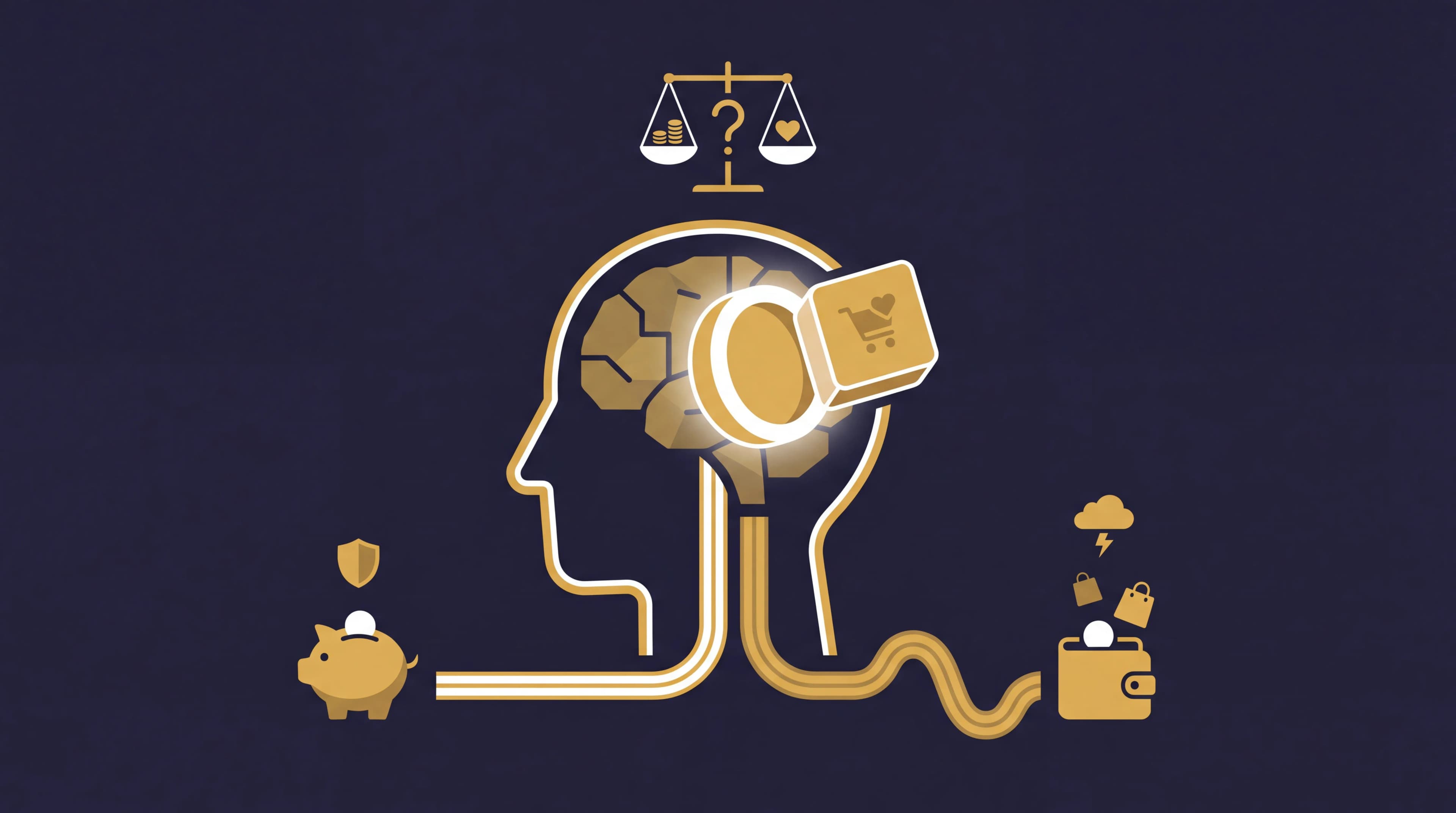
Psychology of Spending: Why You're Not Bad With Money
You check your bank account, see the balance, and feel that familiar sinking sensation in your chest. You promised yourself you would stick to the budget this month. You swore you wouldn't order takeout again. Yet here you are, wondering where the money went and quietly labeling yourself as someone who is just naturally bad with finances.
Take a deep breath and let yourself off the hook. Why do you struggle with money? The answer lies in the psychology of spending: your financial challenges stem from a mismatch between your brain's natural wiring and modern financial systems, not a lack of willpower. The assumption that poor spending habits come from a lack of discipline is one of the most damaging myths in personal finance.
According to consumer research (2024), approximately 63 percent of Americans report that emotions significantly influence their purchasing decisions. The correlation between poor spending outcomes and your personal character is actually incredibly weak. Instead, the evidence points to a much more practical reality. Your spending challenges likely come from a fundamental mismatch between your psychological traits, the way your brain processes information, and the design of the financial systems around you.
According to financial surveys (2025), with 80 percent of Americans reporting at least one financial regret, and 29 percent citing overspending on non-essentials as their primary mistake, we need to stop talking about blame. We need to start talking about psychology.
The Hidden Architecture of Emotional Spending
Emotional spending is a psychological response to environmental stress, not a failure of personal discipline. Most personal finance advice relies heavily on individual responsibility. Just try harder. Just buy less. But this ignores the sophisticated psychological mechanisms that actually drive our behavior.
We must first understand the core concept: Emotional spending — the act of buying items to regulate your mood, relieve stress, or escape negative feelings rather than fulfilling a practical need.
According to retail psychology studies (2023), 74 percent of emotional shoppers report that their purchasing patterns lead to overspending, and 43 percent have accumulated debt specifically through emotional spending. We are looking at something much deeper than simple impulsiveness. Consumer psychology shows us that emotional spending is a natural response to stress and anxiety. It is not a personal failure.
For many of us, shopping provides immediate relief from negative feelings. The anticipation of a purchase, the discovery of something new, and the transaction itself all trigger a dopamine release in your brain. This creates a temporary mood boost that provides a quick escape from stress. When you face a difficult day at work or experience financial anxiety, deciding to buy something is rarely a rational calculation. It is an automatic response to emotional discomfort. Your brain is simply looking for relief.
This behavior makes perfect sense when you look at the broader economic environment. According to economic surveys (2024), 38 percent of Americans report that economic stress has made them spend more. When the future feels unpredictable and financial security feels out of reach, the psychological appeal of securing something tangible right now often outweighs the abstract promise of future security.
You are not making irrational choices. You are responding to an environment of sustained uncertainty by seeking the concrete comfort that buying things provides.
The bottom line: Your brain uses shopping as a coping mechanism for economic uncertainty and stress, making willpower an ineffective tool for long-term change.
How Your Brain Compartmentalizes Money
Human brains naturally categorize money into subjective buckets, leading to inconsistent financial decisions. If you have ever wondered why smart people consistently spend more than they intend to, you need to understand mental accounting.
Mental accounting — a behavioral economics concept where individuals divide their money into different subjective categories based on arbitrary rules, rather than treating all dollars equally.
This creates artificial boundaries in our minds. It allows us to overspend in specific categories while maintaining the illusion that we are in total financial control.
Consider a common scenario. You might carefully limit your grocery spending to a strict weekly amount. You check prices and clip digital coupons. Yet, you might thoughtlessly purchase a coffee or a quick lunch every day without applying that same scrutiny. This happens because the coffee falls into a different mental account (perhaps labeled "small daily needs") that operates under completely different rules.
You probably know that daily convenience spending can add up to $1,500 or $2,000 annually. However, the way your brain files this spending prevents you from integrating that knowledge into your overall financial picture. This is exactly why most money advice fails. It assumes humans operate like calculators, when in reality, our brains are wired to compartmentalize.
The Buy-Now-Pay-Later Trap
This mental accounting trap gets significantly worse when we introduce credit cards and buy-now-pay-later (BNPL) services. Credit cards create physical and temporal distance between the moment of purchase and the pain of payment. According to behavioral economics research (2023), 40 percent of consumers spend more than planned in physical stores, compared to only 25 percent online, partly because of how payment structures alter our perception of cost.
BNPL services exploit this vulnerability through a specific cognitive bias. This is known as the numerosity effect — a cognitive bias where people perceive a cost as lower when it is broken down into smaller, disaggregated payments.
When a $600 refrigerator is presented as four payments of $150, your brain perceives the smaller payment amount as a lower overall cost. It is a predictable consequence of how the human mind processes disaggregated numbers. According to consumer credit reports (2024), it is no wonder that over 40 percent of BNPL users report making late payments in the past year, and one in four Americans regret using these services after realizing their actual obligation.
Here's what this means: Mental accounting and modern payment structures trick your brain into underestimating how much you are actually spending, bypassing your logical financial boundaries.
The Personality-Spending Mismatch
Your core personality traits dictate your financial behaviors and determine which budgeting methods will actually work for you. Emerging research on personality traits reveals that we all have fundamentally different relationships with money based on our natural dispositions. These are not learned behaviors you can simply turn off. They reflect core aspects of who you are.
For example, individuals who are naturally highly conscientious (organized, detail-oriented, and planners) naturally gravitate toward systematic financial management. For them, creating detailed spreadsheets feels like an expression of their fundamental nature. But if you are lower in conscientiousness, trying to maintain those same rigid tracking systems feels terrible. It leads to avoidance behaviors that actually worsen your financial situation.
Agreeableness also plays a counterintuitive role in financial decisions. Research reveals that highly agreeable people are often less likely to save money. They sometimes internalize the false belief that valuing money means they do not value people. For an agreeable person, the standard advice to "save for retirement" might feel selfish. But if that same goal is reframed as "building security to protect your family," the behavior suddenly aligns with their values and becomes highly motivating.
According to behavioral research (2023), when researchers matched savings messages to specific personality traits, participants achieved their savings goals at rates 3.57 times higher than a control group. The problem is not your ability to save. The problem is the alignment between the financial method and your psychological makeup.
We generally fall into different financial archetypes like Free Spirits, Doomsday Preppers, Money Admirers, and Budget Balancers. If you are a Free Spirit who values present experiences over possessions, your challenge is a value structure that prioritizes the now. The solution is not to force yourself to become a rigid Budget Balancer. The solution is to honor your nature by creating a designated "fun fund" that allows for planned spontaneity.
The bottom line: Financial success requires adopting a money management system that aligns with your natural personality traits, rather than fighting against them.
The Manufactured Environment Working Against You
Modern retail and digital environments are scientifically engineered to bypass your rational decision-making and trigger impulse purchases. Understanding your own mind is only half the battle. You also have to recognize that the modern financial environment is deliberately designed to exploit your psychological vulnerabilities.
The design of BNPL services is a perfect case study. These services integrate directly into shopping platforms with single-click checkouts, removing the natural friction that usually gives you time to reflect. By the time you reach the checkout page, you have already spent significant mental energy researching product details. This depletes the cognitive resources you need to evaluate if the purchase is actually a good idea.
Social media algorithms create another layer of environmental pressure. They activate social comparison mechanisms, particularly for those vulnerable to the fear of missing out. Algorithms target advertisements based on your previous browsing patterns and demographic traits. This creates a feedback loop where the more you engage with consumption-oriented content, the more you are pushed to buy.
Even retail environments (both physical and digital) use sensory stimulation to facilitate impulse purchases. Digital stores use notifications, countdown timers, and limited-inventory warnings to create artificial urgency. According to market analysis (2024), with food delivery growing from 9 percent of food service spending in 2019 to 21 percent in 2024, consumption has been optimized purely for convenience. You are fighting an uphill battle against systems designed by experts to make you part with your cash.
Here's what this means: You are constantly battling algorithms and store designs optimized to deplete your cognitive resources and maximize your spending.
The Scarcity Mindset and the Value Paradox
Financial scarcity alters your brain's neurology, forcing a focus on immediate survival over long-term financial planning. The relationship between financial stress and spending behavior forms a cycle that basic financial education simply cannot break.
When you experience financial strain, your brain's threat-detection systems activate. This introduces the scarcity mindset — a psychological state where a lack of resources consumes mental bandwidth, impairing long-term decision-making. Brain imaging studies show that a scarcity mindset increases activity in the region responsible for valuation processes, while decreasing activity in the region responsible for goal-directed decisions. When money is tight, you are neurologically more prone to prioritize immediate pleasure over practical utility.
This leads to a fascinating consumer behavior trend known as the value equation paradox.
Value equation paradox — a consumer trend where individuals strictly cut back on essentials while simultaneously splurging on non-essential luxury items.
According to global consumer surveys (2024), 79 percent of surveyed consumers report trading down to save money. Yet, they are making unexpected trade-offs. According to the same global consumer surveys (2024), nearly 19 percent of consumers plan to cut back on essential categories like groceries while simultaneously splurging on non-essentials.
Why would someone rigorously limit their grocery budget only to buy a high-end jacket?
Psychologists call this the "restoration of agency" response. Financial constraint threatens your sense of control and autonomy. Buying a premium item restores that feeling of personal agency. It proves to you that you still have the power to make independent choices. It might not look like rational economics, but it makes perfect psychological sense. To fix this, you have to find ways to spend less without feeling deprived of your autonomy.
The bottom line: Splurging when money is tight is a psychological attempt to restore your sense of control and personal agency.
How to Align Your Spending Habits With Your Brain
Building a sustainable financial system requires working with your psychological tendencies rather than relying on willpower. Recognizing that your spending challenges are a psychological mismatch gives you the power to actually change things. Instead of relying on brute-force willpower, you can build systems that work with your natural tendencies.
First, practice financial mindfulness. Financial mindfulness — the practice of observing your financial reality and spending urges without judgment or emotional reaction. Set aside time once a month to review your statements in a calm, structured environment. Research shows that people who practice financial awareness have higher credit scores and are less likely to ignore their bills.
Second, embrace intentional spending. Identify what you genuinely value (whether that is security, travel, family, or personal growth) and consciously direct your resources there. This is completely different from restrictive budgeting. You are not limiting your spending; you are directing it toward what actually matters to you.
Third, use mental accounting to your advantage. Since your brain naturally wants to compartmentalize money, do it deliberately. Create a specific, funded account just for your daily coffees or weekend outings. When the money in that specific account is gone, it is gone. This brings those small purchases into your conscious awareness.
Finally, design your environment by adding friction to bad habits and removing it from good ones. Delete your saved credit card information from your favorite retail sites. Make yourself get up and find your wallet if you want to buy something online. At the same time, remove friction from your savings by setting up automatic transfers the day your paycheck hits your account.
Here's what this means: By adding friction to bad habits and removing it from good ones, you can automate better financial choices without relying on discipline.
Common Questions About the Psychology of Spending
Why do I keep spending money when I know I shouldn't?
You keep spending money because emotional spending acts as a psychological coping mechanism for stress and anxiety. When you feel overwhelmed, your brain seeks the immediate dopamine release that comes from making a purchase. It is an automatic response to discomfort rather than a rational choice.
What is emotional spending?
Emotional spending is the act of buying items to regulate your mood, relieve stress, or escape negative feelings rather than fulfilling a practical need. It happens when you use shopping as a quick fix for emotional discomfort. Over time, this habit can lead to significant financial strain and debt.
How can I stop impulse buying online?
You can stop impulse buying by introducing deliberate friction into your purchasing process, such as enforcing a mandatory 24-hour waiting period. Additionally, deleting saved credit card information from retail websites forces you to slow down and evaluate if the purchase aligns with your goals.
Why does budgeting fail for so many people?
Budgeting often fails because traditional methods rely purely on willpower and ignore a person's natural psychological traits. If a rigid budgeting system clashes with your core personality, it will lead to avoidance behaviors and eventual financial frustration. Successful money management requires a system tailored to your unique behavioral tendencies.
Your One Next Step
You do not need to overhaul your entire financial life today. Your next step is to implement a structured pause.
The next time you feel the urge to make a non-essential purchase, force a 24-hour waiting period. But do not just passively wait. Use that time to identify the exact trigger that made you want to buy the item. Were you stressed about work? Did you see it on social media? Were you feeling a lack of control? Writing down the emotion activates the executive control center of your brain, overriding the automatic impulse to spend.
Once you understand what is actually driving your spending, you can stop fighting yourself and start building a system that works for you.
Your Money. Your Terms.
Listen to this article
AI-generated audio · Voices by ElevenLabs
Get smarter about money
One practical tip per week. No spam, no hype — just clear steps toward financial progress.

Sammy Dynamo
Software Engineer | CS Student | Technopreneur, Dyxium Inc
Related Articles
10 min read
Mindful Spending2026 Car Tax Deduction: A Math Reality Check
Thinking of buying a car for the 2026 tax deduction? With average ownership costs hitting $12,297...
Sammy Dynamo
11 min read
Mindful SpendingCost of Raising a Child in 2026: A Financial Guide
The cost of raising a child in 2026 exceeds $303,000. Discover where the money goes and...
Sammy Dynamo
13 min read
Mindful SpendingSaying No to Expensive Weddings: Money Boundaries
Struggling with the cost of being a guest? Learn how saying no to expensive weddings and...
Sammy Dynamo