Save for a House Down Payment While Paying High Rent
Save for a House Down Payment While Paying High Rent
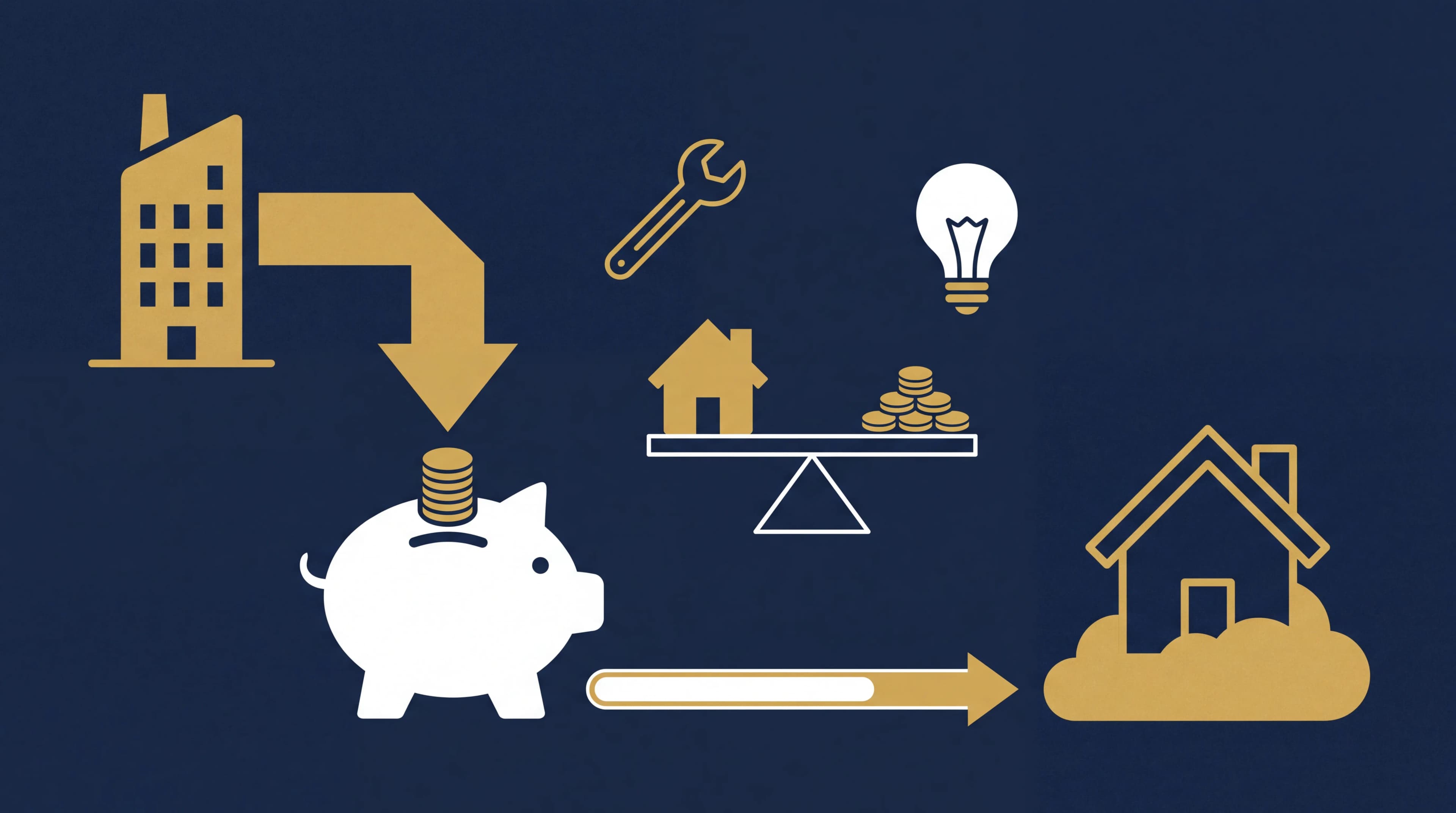
Trying to save for a house while paying high rent feels like trying to fill a bucket with a hole in the bottom. Every time you manage to set a little extra money aside, the first of the month rolls around and drains your progress.
To successfully save for a house down payment while paying high rent, you must lower your down payment target to 3 to 5 percent, build a basic emergency fund first, and automatically redirect future raises into a dedicated high-yield savings account.
If you feel like you are falling behind, you are not doing the math wrong. The math is just incredibly difficult right now. Saving for a house is not simply a matter of willpower or skipping your morning coffee. It is a major financial challenge that sits right at the intersection of rising housing costs, stagnant affordability, and the very normal human struggle to save for long-term goals.
Let us look at the actual numbers, clear up a few massive misconceptions about buying a home, and build a practical strategy to grow your house fund without making yourself miserable.
The Math Against Renters Saving for a Down Payment
High rent prices mathematically restrict the ability of average earners to save for a down payment. Before you beat yourself up for not having a massive savings account, you need to look at the environment you are operating in. Renting in the United States is expensive, and it has been getting worse.
According to the Federal Reserve's Survey of Household Economics and Decisionmaking (2024), the median reported monthly rent climbed to $1,200, up from $1,000 in 2022. That is roughly a 10 percent annual increase over two years. When your rent goes up that fast, you either have to make more money, cut other expenses, or accept that a larger chunk of your paycheck is going straight to your landlord.
Government and housing experts use a standard rule to measure affordability. Cost burdened — a financial state where you spend more than 30 percent of your gross income on housing. If you spend more than 50 percent, you are "severely cost burdened."
According to the Congressional Research Service (2024), 49.4 percent of all renters fall into the cost-burdened category. Even worse, more than a quarter of all renters are severely cost burdened. An independent analysis confirms this trend; according to Apartment List (2024), 51.8 percent of renters are cost burdened nationally.
This means that if you are struggling to save, you are completely normal. Half of the renting population is in the same boat. If you are learning how to budget when rent is 40% of your income, your priority is just keeping your head above water. Finding room for a down payment takes a very specific, deliberate approach.
The bottom line: If you are struggling to save, you are completely normal, as half of all renters face the exact same mathematical barrier.
Why You Do Not Need a 20 Percent House Down Payment
A 20 percent down payment is a myth that prevents many renters from buying a home. One of the biggest roadblocks to saving for a house is a psychological one. You might be aiming for a target that is completely unnecessary.
According to NerdWallet (2024), 72 percent of renters believe a 20 percent down payment is required to buy a home. If you want to buy a $400,000 house, 20 percent is $80,000. When you are paying high rent, saving $80,000 feels impossible. So, many people simply give up and do not even try.
Here is the reality. According to the National Association of Realtors (2024), the median down payment for a first-time home buyer was just 9 percent.
There are plenty of conventional mortgage programs that allow you to put down 3 percent or 5 percent. FHA loans require 3.5 percent. VA loans and USDA loans can require zero down if you qualify.
Yes, putting down less than 20 percent usually means you will have to deal with private mortgage insurance. Private mortgage insurance (PMI) — a monthly fee added to your mortgage if you put down less than 20 percent, designed to protect the lender. Your monthly payment will also be higher because you are borrowing more money. But a 9 percent down payment on a $400,000 home is $36,000. That is still a lot of money, but it is less than half of the $80,000 you might have thought you needed.
Here's what this means: Lowering your target from 20 percent to 3 or 5 percent makes the goal of homeownership achievable much sooner.
Build an Emergency Fund Before Your House Fund
A fully funded emergency fund must precede any aggressive savings for a house down payment. When you are desperate to buy a house, it is tempting to throw every spare dollar into your down payment fund. But skipping your basic financial safety net is a massive mistake.
According to Bankrate (2024), 27 percent of Americans have zero emergency savings. Less than half of the respondents had enough saved to cover three months of expenses.
If you are renting, episodes of financial stress can easily throw you off track. According to the Federal Reserve (2024), 21 percent of renters reported being behind on their rent at some point in the past year.
You cannot buy a house if a single medical bill or car repair wipes out your finances. Before you start aggressively saving for a down payment, you need a basic emergency fund. If you are debating how to balance these competing priorities, it helps to understand the real math behind whether you should buy or rent in 2026. Make sure your foundation is secure before you try to build a house on top of it.
The bottom line: You cannot safely buy a house if a single unexpected expense will wipe out your finances, so secure your safety net first.
Use the "Save More Tomorrow" Strategy for Your Down Payment
The most effective way to save for a down payment while paying high rent is to commit future income increases to your savings. So how do you actually find the money to save when rent is eating your paycheck? The answer comes from behavioral economics.
Behavioral economists Richard Thaler and Shlomo Benartzi created a famous program called "Save More Tomorrow" (SMarT). They knew that people hate seeing their take-home pay go down due to a psychological concept called loss aversion. Loss aversion — a behavioral economics concept explaining why the pain of losing money feels worse than the joy of gaining it. This makes cutting your current budget incredibly painful.
Applying Behavioral Economics to Your Savings
Instead of asking people to cut their current spending, the SMarT program asked them to commit their future money. Employees agreed in advance that every time they got a raise, a portion of that new money would automatically go into their retirement savings.
The results were incredible. Average saving rates for participants jumped from 3.5 percent to 13.6 percent over about three years. Because the savings increase was tied to a raise, their paychecks never went down. They just grew a little slower than they would have otherwise.
You can use this exact same psychology for your house down payment. Right now, commit to a tiny monthly transfer to your down payment fund. Even $50 a month is fine. Then, make a rule. Anytime your income goes up (whether through an annual raise, a bonus, a tax refund, or a new job), you will send 50 percent of that new money directly to your house fund.
Here's what this means: By automatically transferring half of every future raise or bonus to your house fund, you accelerate your savings without ever feeling a cut to your current budget.
Alternative Sources for a House Down Payment
Most first-time homebuyers rely on a combination of personal savings and outside financial help to fund their down payments. It is helpful to know how other people are actually funding their purchases. If you are comparing your progress to a friend who just bought a house, you might not have the full story.
According to the National Association of Realtors (2024), 69 percent of first-time buyers used their own personal savings for their down payment. But personal savings is rarely the only source.
A full 25 percent of first-time buyers relied on a gift or a loan from a relative or friend. Another 21 percent used other financial assets, and 7 percent used an inheritance.
If you are saving for a down payment entirely on your own, with no family help and no existing investments to sell, you are playing on hard mode. It will take you longer, and that is perfectly okay. Do not judge your chapter two against someone else's chapter ten (especially if their chapter ten was funded by their parents).
The bottom line: Do not compare your savings progress to others, as many buyers use family gifts or inheritances to cross the finish line.
Setting a Realistic Timeline to Save for a House
Saving for a house down payment on a median income while paying high rent is a multi-year financial project. Because of high rents and the realities of median incomes, you need to set proper expectations.
According to the U.S. Bureau of Labor Statistics (2024), the median weekly earnings for a full-time worker aged 25 to 34 was $1,056 in the first quarter. That translates to about $54,912 a year. If you are paying the median rent of $1,200 a month, rent is consuming about 26 percent of your gross income. After taxes, groceries, and student loans, the margin for saving is thin.
Adjusting Your Homeownership Expectations
According to Zillow (2024), it takes about 8.5 years to save a 20 percent down payment for a typical single-family home assuming a household saves 10 percent of its income every single year.
If you target a smaller starter home instead, you can cut that timeline down to roughly 7.2 years to reach the point where buying makes more financial sense than renting.
This data is sobering, but it is also freeing. If you are wondering how much money you should have saved by 30, know that buying a house is not a race you have to win in 12 months. It is a long-term habit you build over half a decade or more.
Here's what this means: Buying a house is a long-term habit built over half a decade, not a race you have to win in twelve months.
Common Questions About Saving for a Down Payment
How much should I save for a house down payment?
You should aim to save between 3 and 5 percent of the home's purchase price for a down payment as a first-time buyer. While many believe 20 percent is required, conventional loans and FHA loans allow for much smaller down payments. Lowering your target makes homeownership achievable much faster.
Why is it so hard to save for a house while renting?
It is hard to save for a house while renting because rent prices often consume more than 30 percent of an average earner's gross income. This leaves very little disposable income at the end of the month to allocate toward long-term savings goals. High housing costs mathematically restrict your ability to build wealth quickly.
What is the best way to save for a down payment?
The best way to save for a down payment is to open a dedicated high-yield savings account and automate your monthly contributions. Additionally, committing a large percentage of any future raises or bonuses directly to this fund will accelerate your progress without impacting your current lifestyle.
When should I stop saving for an emergency fund and start saving for a house?
You should stop prioritizing your emergency fund and start saving for a house only after you have saved enough to cover three to six months of basic living expenses. A fully funded safety net is essential to ensure a single unexpected expense does not derail your homeownership goals.
Your One Next Step
Open a brand new, separate high-yield savings account today and name it "House Fund."
Do not keep this money in your normal checking account, and do not mix it with your emergency fund. Mental accounting is a powerful tool. When you see a dedicated account with a specific name, you are much less likely to raid it for a vacation or a new laptop.
Set up an automatic transfer of just $25 or $50 a month to start. It does not matter if the amount feels too small right now. You are building the infrastructure. Once the account is open and the automation is running, you can use the "Save More Tomorrow" strategy to increase your contributions the next time you get a raise.
Your Money. Your Terms.
Listen to this article
AI-generated audio · Voices by ElevenLabs
Get the 2026 Wealth Starter Kit
Free spreadsheet budget models, 2026 tax deduction checklists, and weekly practical playbooks. No spam, no affiliate shills.

Sammy Dynamo
Software Engineer | CS Student | Technopreneur, Dyxium Inc
Related Articles
12 min read
Saving & InvestingFinancial Order of Operations: First Paycheck Guide
Master your money with this 2026 financial order of operations. Discover exactly where to route your...
Sammy Dynamo
11 min read
Saving & InvestingHSA in 2026: Why the Standard Money Flowchart is Wrong
The standard money flowchart puts your HSA at the bottom. Discover why rising health costs mean...
Sammy Dynamo
12 min read
Saving & Investing2026 Cash Ladder: Combine HYSAs, T-Bills, and I Bonds
Learn how to build a 2026 cash ladder using HYSAs, T-Bills, and I Bonds. Maximize your...
Sammy Dynamo