2026 Cash Ladder: Combine HYSAs, T-Bills, and I Bonds
2026 Cash Ladder: Combine HYSAs, T-Bills, and I Bonds
Building a reliable emergency fund can feel like an impossible task when living costs keep inching up. You are not alone if you feel like every time you manage to save a few hundred dollars, an unexpected car repair or medical bill wipes it out.
But how do you safely grow your savings without locking up money you might need tomorrow? The answer is a cash ladder. A cash ladder — a financial strategy that splits your short-term savings across different low-risk accounts to maximize interest while maintaining access to your cash — is the perfect solution. By thoughtfully combining High-Yield Savings Accounts (HYSAs), Treasury bills, and Series I savings bonds, you can design a flexible safety net that balances easy access, safety, and a solid return.
The good news is that the mid-2020s interest rate environment has created a unique opportunity for savers. For the first time in over a decade, keeping your money in cash or near-cash assets actually pays a meaningful return. Here is how to put that money to work.
The Reality of Emergency Savings in 2026
The reality of emergency savings today is that most Americans lack a sufficient cash buffer to handle unexpected expenses. Before we look at how to structure your savings, it helps to understand the broader financial picture. The truth is that many young professionals and new earners are operating with a very thin financial margin.
According to the Federal Reserve Board’s Survey of Household Economics and Decisionmaking (2024), 63 percent of adults reported they could cover a $400 emergency expense with cash or its equivalent. However, 13 percent said they would be unable to pay a $400 expense by any means at all.
Private surveys show an even steeper uphill climb. According to the Bankrate Annual Emergency Savings Report (2026), just 47 percent of Americans had enough liquid cash to cover a $1,000 emergency expense from their savings. Nearly one quarter (24 percent) reported having no dedicated emergency savings whatsoever. When asked what was holding them back, respondents pointed to rising prices (53 percent), too many daily expenses (43 percent), and existing debt (24 percent).
Generational differences also play a big role. According to NerdWallet (2025), only 42 percent of Americans had an emergency fund of at least $2,000. When you break that down by age, only 36 percent of millennials and 31 percent of Gen Z respondents had hit that $2,000 mark.
If these numbers sound familiar, do not get discouraged. The goal is not to fix everything overnight. The goal is to start putting your money to work so that your savings actually grow while they sit there. If you are starting from zero, learning how to build a $1,000 emergency fund in 90 days is your best first move. Once you have that baseline, you can start building your ladder.
The bottom line: Most people are under-saved, making it critical to maximize the growth and efficiency of whatever cash you do have.
Why a Basic Savings Account Is Costing You Money
Keeping your emergency fund in a traditional savings account is actively costing you money due to inflation and rock-bottom interest rates. If you have money sitting at a big national bank, you are likely missing out on free money.
Following the aggressive interest rate hikes by the Federal Reserve starting in 2022, yields on short-term government securities and deposit accounts jumped significantly. However, traditional brick-and-mortar banks have been incredibly slow to pass those higher rates on to their customers.
As of mid-2025, the national average savings rate hovered around a dismal 0.38 percent. Meanwhile, top-tier online high-yield savings accounts were offering annual percentage yields (APYs) of 4.00 to 4.66 percent.
Let us look at the real math on a $10,000 savings balance. In a traditional account earning 0.38 percent, your money would earn about $38 over a year. In a high-yield savings account earning 4.00 percent, that same $10,000 would earn $400. That is a $362 difference for doing absolutely nothing other than moving your money to a different institution.
This massive gap is the foundation of your cash ladder. You want to ensure that every dollar you save is earning a competitive rate, especially when high-yield savings rates drop and you need to know where to move your money.
Here's what this means: Moving your money from a traditional bank to a high-yield account is the easiest way to generate hundreds of dollars in passive income with zero added risk.
How a Cash Ladder Maximizes Your Emergency Fund
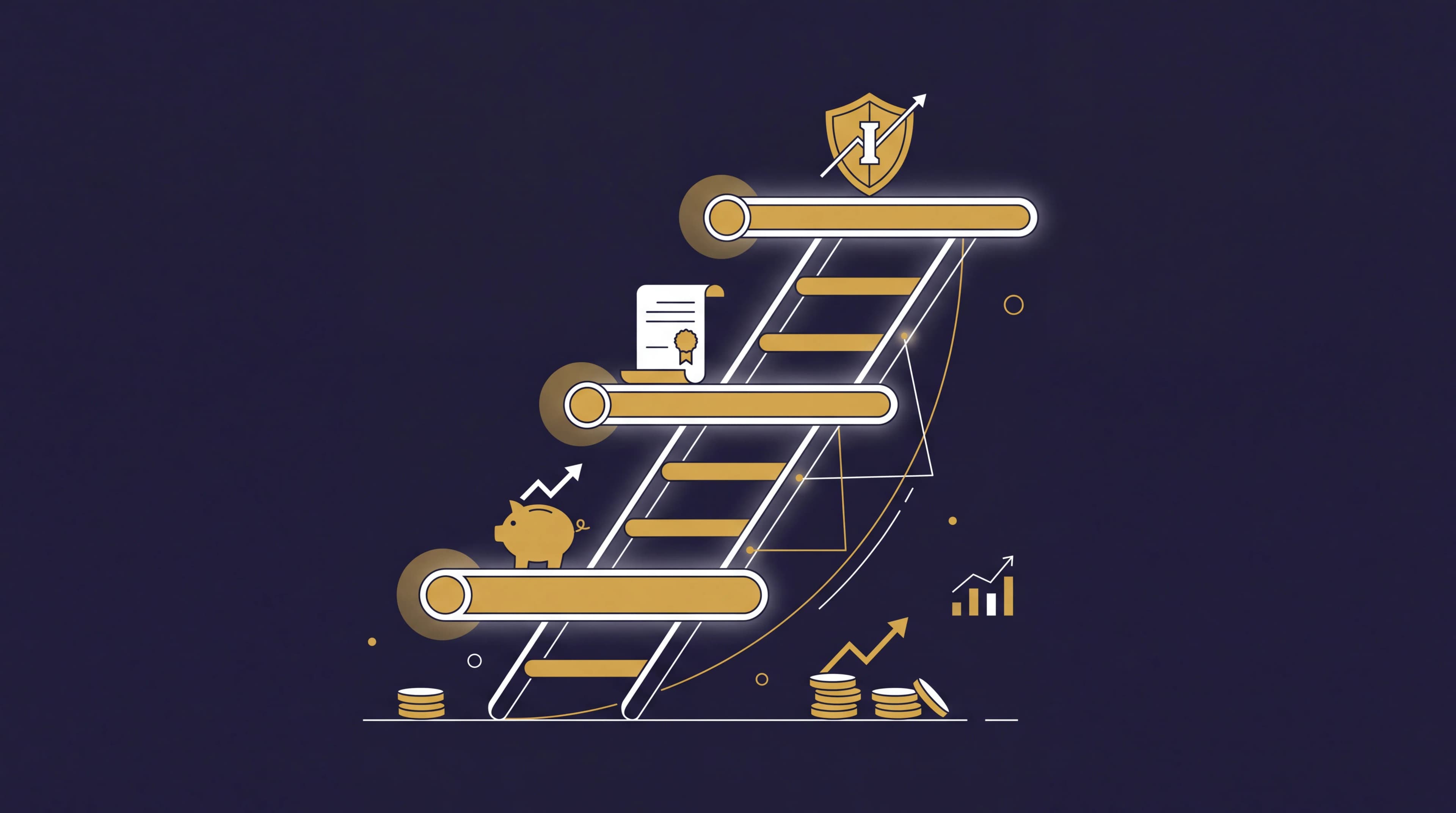
A cash ladder maximizes your emergency fund by organizing your savings into different tiers based on when you might need the money. Instead of dumping all your cash into one account, you divide it into "rungs."
Rungs — specific tiers of a cash ladder that balance liquidity (how fast you can get your cash) with yield (how much interest it earns) — are the secret to this strategy.
The bottom rung is for money you might need today or tomorrow. It needs to be highly liquid and completely safe. The middle rungs are for money you might need in a few months. The top rungs are for cash you probably will not need for a year or more.
By accepting slightly less immediate access on the higher rungs, you can usually secure a better or more stable interest rate, while protecting your money from inflation. For anyone wondering why the 3-month emergency fund is dead and how to save for 12 months instead, a cash ladder makes holding larger amounts of cash much more efficient.
The bottom line: A cash ladder lets you earn higher interest on the bulk of your savings while keeping a smaller, highly liquid portion available for immediate emergencies.
Building the 3 Rungs of a Cash Ladder
To build a successful 2026 cash ladder, you need to utilize three specific financial tools, each serving a distinct purpose in your overall safety net.
Rung 1: The High-Yield Savings Account
Your HYSA is the foundation of your cash ladder, built for immediate liquidity and simplicity.
High-Yield Savings Account (HYSA) — a deposit account that pays a significantly higher interest rate than traditional savings accounts while offering the same FDIC protection.
An HYSA operates exactly like a regular savings account. You can transfer money in and out easily, your principal balance will never drop, and your funds are protected by FDIC insurance up to statutory limits.
The downside of an HYSA is that the interest rate is variable. The bank can change your APY at any time based on what the Federal Reserve does. If broader interest rates fall, your HYSA rate will fall right along with them.
How to use it: Keep one to two months of living expenses in your HYSA. This is your immediate shock absorber for things like a sudden flat tire, an unexpected vet bill, or a miscalculated utility payment. You want this money available within 24 to 48 hours.
Here's what this means: Your HYSA is your financial shock absorber for immediate, unexpected expenses that require cash on hand within 48 hours.
Rung 2: Treasury Bills for Predictable Returns
Treasury bills are the perfect middle rung for your cash ladder because they lock in your interest rate for a set period.
Treasury bills (T-bills) — short-term debt obligations backed by the U.S. government that mature in one year or less. They are issued with maturity dates ranging from four weeks to 52 weeks.
In recent years, T-bills have offered excellent returns. According to the Federal Reserve Bank of St. Louis (2025), the 4-week Treasury bill averaged 5.05 percent in 2024 and 4.12 percent in 2025. Through late 2024 and into 2026, short-dated market rates generally stayed in the low to mid 4 percent range.
T-bills work a bit differently than a savings account. You buy them at a discount to their face value. For example, you might pay $990 for a $1,000 T-bill. When the bill matures in a few months, the government pays you the full $1,000. The $10 difference is your interest.
There are two major benefits to using T-bills in your cash ladder. First, you lock in your interest rate for the duration of the bill. If HYSA rates drop next month, your T-bill rate stays exactly the same until it matures. Second, the interest you earn on T-bills is exempt from state and local income taxes. If you live in a high-tax state, this makes your effective return even higher.
How to use it: Use T-bills for months three through six of your emergency fund. You can set up a rolling ladder by buying bills that mature at different times (for example, buying a 4-week, 8-week, and 12-week bill). As each one matures, you can either cash it out if you need the money, or automatically reinvest it into a new bill. You can buy them directly through TreasuryDirect.gov or through most major brokerage accounts.
The bottom line: T-bills allow you to lock in high interest rates for a few months at a time, shielding you from sudden rate drops while saving on state taxes.
Rung 3: I Bonds for Long-Term Inflation Protection
Series I savings bonds are the ultimate top rung for your cash ladder because they guarantee your money will outpace inflation.
Series I savings bonds (I bonds) — a U.S. Treasury asset designed specifically to protect your savings from inflation by combining a fixed interest rate with a variable inflation rate.
The interest rate on an I bond is a composite of two parts. First, there is a fixed rate that stays the exact same for the 30-year life of the bond. Second, there is a variable inflation rate that adjusts every six months based on changes in the Consumer Price Index.
In 2024, the Treasury offered a relatively high fixed rate of 1.30 percent. As inflation moderated, they adjusted this fixed rate down slightly. For I bonds issued from November 2025 through April 2026, the composite rate was 4.03 percent (combining a 0.90 percent fixed rate with a 3.12 percent annualized inflation rate). For bonds issued from May to October 2026, the composite rate was 4.26 percent (a 0.90 percent fixed rate plus a 1.67 percent semiannual inflation rate).
Getting a guaranteed 0.90 percent return above the rate of inflation is a powerful way to protect your purchasing power over time. Plus, the interest on I bonds grows tax-deferred until you cash them in, and they are also exempt from state and local taxes.
However, I bonds come with strict rules. You cannot cash them in for the first 12 months after purchase. Period. If you cash them in between years one and five, you will pay a penalty equal to the last three months of interest.
How to use it: Because of the one-year lockup period, I bonds belong on the highest rung of your cash ladder. They are perfect for the outer layers of a large emergency fund (months seven through twelve) or cash you are saving for a house down payment several years away. You can purchase up to $10,000 in I bonds per calendar year per person via TreasuryDirect.gov.
Here's what this means: I bonds are the ultimate inflation shield for the long-term portion of your emergency fund, provided you don't need the money in the first 12 months.
Example: Building Your 2026 Cash Ladder
Building your 2026 cash ladder requires dividing your total savings goal into immediate, short-term, and long-term buckets. Putting this all together does not have to be complicated. Let us look at a practical example.
Assume your basic living expenses are $3,000 a month, and you want to build a six-month emergency fund totaling $18,000. Here is how you might structure that cash ladder in 2026.
Rung 1: The Immediate Buffer ($6,000)
You keep two months of expenses in a high-yield savings account earning around 4.00 percent. This $6,000 is fully liquid. If your car breaks down tomorrow, you can transfer the funds to your checking account instantly.
Rung 2: The Short-Term Locks ($6,000)
You put the next two months of expenses into Treasury bills. You might buy three separate $2,000 T-bills with maturities of 4 weeks, 8 weeks, and 12 weeks, earning around 4.20 percent. Every four weeks, one of these bills matures. If you do not need the cash, you simply set it to reinvest into a new 12-week bill.
Rung 3: The Inflation Shield ($6,000)
You put the final two months of expenses into Series I savings bonds. This money is locked up for the first year, but because you have $12,000 in HYSAs and T-bills ahead of it, you are highly unlikely to need it during that lockup period. After year one, this money becomes a fully accessible part of your emergency fund that is permanently protected from inflation.
The bottom line: This tiered structure gives you the peace of mind of having cash on hand, while optimizing your tax situation and protecting your money against rising prices.
Common Questions About Cash Ladders
What is a cash ladder?
A cash ladder is a financial strategy that divides your savings across different accounts based on when you need the money. By using a mix of HYSAs, T-bills, and I bonds, you can maximize your interest rates while keeping emergency funds accessible. This approach balances liquidity with higher yields.
How much money should I put in a cash ladder?
You should aim to put three to six months of living expenses into your cash ladder. Keep the first one to two months in a highly liquid HYSA, and distribute the remaining balance into short-term T-bills and long-term I bonds. This ensures you have immediate cash for emergencies while the rest earns higher interest.
Why use T-bills instead of just a high-yield savings account?
Treasury bills allow you to lock in a guaranteed interest rate for a set period, protecting you if HYSA rates drop. Additionally, the interest earned on T-bills is exempt from state and local income taxes. This makes them highly tax-efficient for the middle rungs of your cash ladder.
When can I withdraw money from an I bond?
You cannot withdraw money from a Series I savings bond during the first 12 months after purchase. If you cash it in between years one and five, you will face a penalty equal to the last three months of interest. Because of this lockup period, I bonds should only be used for the long-term tier of your cash ladder.
Your One Next Step
If your emergency savings are currently sitting in a traditional bank account earning less than 1 percent, your single next step is to open a high-yield savings account and move your money. You do not need to figure out Treasury bills or I bonds today. Just getting your baseline cash out of a near-zero interest account and into an HYSA paying around 4 percent is the biggest and easiest win for your financial foundation.
Your Money. Your Terms.
Listen to this article
AI-generated audio · Voices by ElevenLabs
Get smarter about money
One practical tip per week. No spam, no hype — just clear steps toward financial progress.

Sammy Dynamo
Software Engineer | CS Student | Technopreneur, Dyxium Inc
Related Articles
12 min read
Saving & InvestingFinancial Order of Operations: First Paycheck Guide
Master your money with this 2026 financial order of operations. Discover exactly where to route your...
Sammy Dynamo
11 min read
Saving & InvestingHSA in 2026: Why the Standard Money Flowchart is Wrong
The standard money flowchart puts your HSA at the bottom. Discover why rising health costs mean...
Sammy Dynamo
11 min read
Saving & InvestingSave for a House Down Payment While Paying High Rent
Learn how to save for a house down payment while paying high rent. Discover the real...
Sammy Dynamo